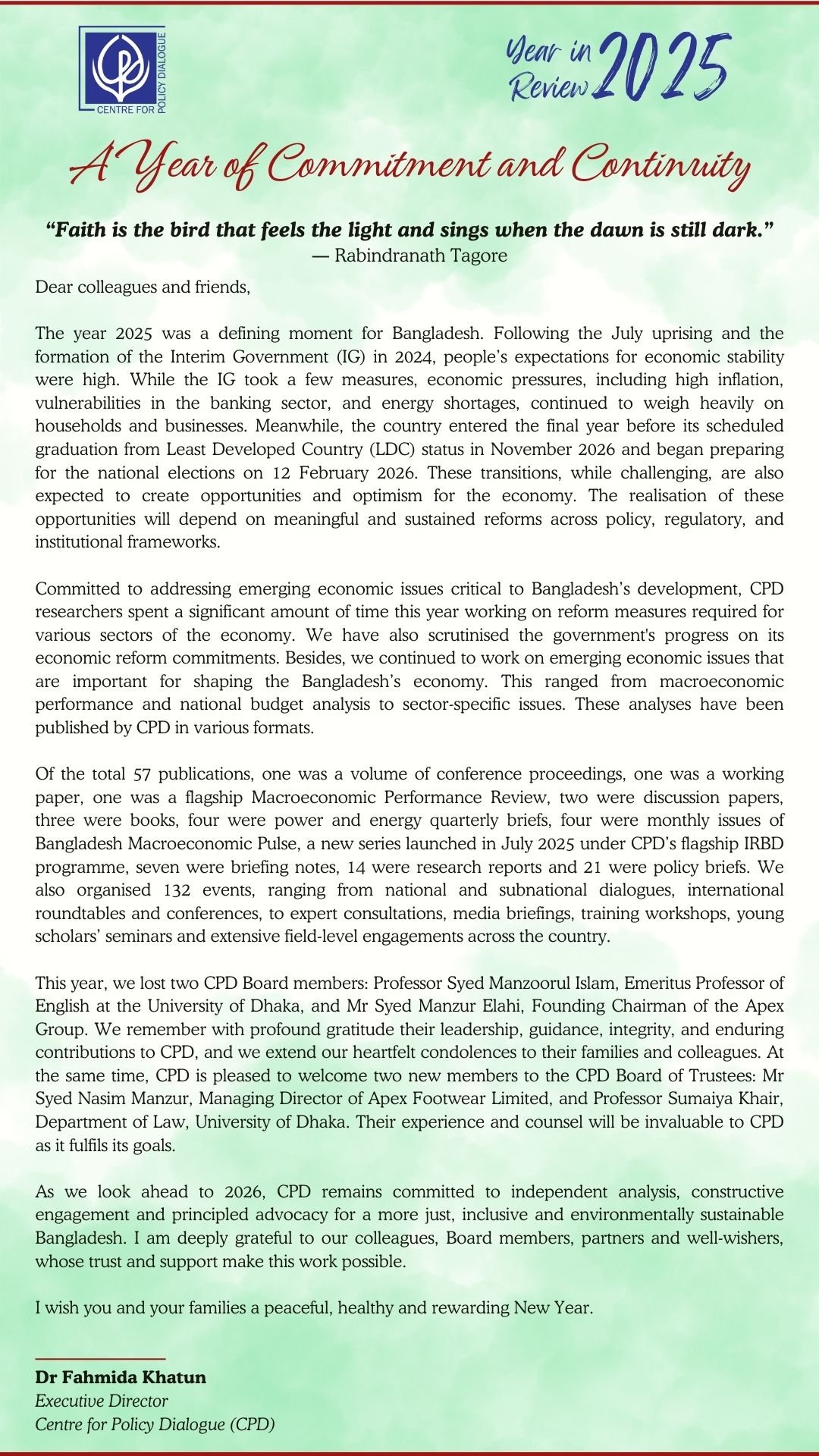
In 2025, CPD family mourned the passing of two Board members, Professor Syed Manzoorul Islam and Mr Syed Manzur Elahi. Professor Islam, Emeritus Professor of English at the University of Dhaka, was a revered academic and award-winning writer whose reflections on education and society enriched CPD’s intellectual work. |
|
CPD Climate Week 2025 was a four-day initiative to turn global and national climate ambitions into fair and inclusive action. Under the theme “Transforming Ambition into Action”, it brought together policymakers, researchers, youth, civil society, and the private sector for an international conference, focused dialogues, and thematic presentations and discussions on climate justice, finance, innovation, and resilience. |
|
CPD’s dialogue on 365 days of the interim government assessed how political transition and economic management are intersecting in Bangladesh. Participants noted that, despite some stabilising steps, inflation, weak private investment, banking fragilities and energy insecurity continue to weigh on the economy. |
|
CPD brought together youth from across Bangladesh to debate how employment, health and technology reforms can better serve their generation. Participants highlighted skills gaps, the digital gender divide and barriers to affordable healthcare, calling for stronger digital skills training, better quality jobs and more accessible tech-enabled health services. |
|
Bangladesh continued to face a demanding macroeconomic context, shaped by fiscal pressure, sluggish revenue growth, persistent inflation, external risks and rising concerns over banking stability. In this environment, CPD prioritised macroeconomic stability and convened a series of engagements to assess challenges and propose reforms. |
|
Under this theme, CPD worked to connect climate diplomacy, green energy transition, and sustainable resource use. It brought together Bangladeshi and Australian stakeholders to deepen collaboration on climate finance, renewable energy and a greener economic pathway. |
|
Bangladesh’s power and energy sector continued to face fiscal strain, policy delays, and a slow renewable rollout. In response, CPD focused on practical reform options that link financing, governance, and implementation. CPD’s analysis of the sector’s budget underscored persistent subsidy pressures and the gap between energy transition commitments and resource allocation. |
|
Under this theme, CPD pursued a coherent agenda to make Bangladesh’s labour market fairer and social protection more comprehensive. It advised the Labour Reform Commission on wages, safety, union rights, gender equality and the elimination of child and forced labour. |
|
CPD advanced its governance and rights agenda by combining national reform debates with field-level citizen engagement. At the national level, it examined whether accountability of the majority party is better served through reforms within the existing unicameral parliament or a possible second chamber, convening expert and multi-stakeholder dialogues on checks and balances, committee oversight and independent watchdogs. |
|
CPD advanced its gender and inclusion work by strengthening both evidence and advocacy. An expert group meeting on women in agriculture helped frame how women’s often unpaid farm work contributes to production and how its economic value can be measured and better recognised in policy. |
|
CPD deepened its regional engagement by partnering with the Nepal Economic Forum to convene high-level Bangladesh–Nepal dialogues in Dhaka and Kathmandu, positioning bilateral cooperation as a lever for shared prosperity. Across these exchanges, stakeholders underscored untapped potential in trade, investment and regional value chains, calling for lower tariffs and non-tariff barriers, smoother customs and logistics, and clearer rules for cross-border investors and SMEs. |
|
CPD strengthened the next generation of policy analysts through targeted research and learning initiatives. The 62nd Young Scholars Seminar Series featured young researchers’ work on demonetisation, counterfeit currency and remittance cash incentives, followed by critical peer feedback from senior economists. |
|
CPD deepened its future-oriented work through two notable initiatives on education and employment. In partnership with NAEM and UNESCO, it helped unpack the findings of “The Price of Inaction,” warning of catastrophic economic losses if Bangladesh fails to secure foundational learning for all children and calling for higher education spending, stronger teacher support, and more inclusive, gender-sensitive schools. Through the foresight study Life After Life: Future of Work in Bangladesh, CPD also convened a scenario-building workshop with experts, youth, activists, and business leaders to explore how automation, LDC graduation, digitalisation, and demographic change could reshape jobs by 2035 and to identify policy options for a more inclusive and resilient labour market. |
|
Beyond research and dialogue, the CPD family made time in 2025 to relax, celebrate and connect with one another. Colleagues spent a retreat at BRAC CDM in Gazipur, enjoying games, conversations and time away from everyday routines. At the office, CPD marked International Women’s Day with reflections and celebrations led by staff, and gathered for its annual iftar and dinner with Board members. Birthdays of colleagues were also celebrated together, while a relaxed fruit feast turned the dining room into a space for shared laughter, stories and seasonal flavours, reinforcing the sense of community that supports CPD’s work. |
|
House 40/C, Road No 11 (new) Dhanmondi
Dhaka, 1209, Bangladesh |
|
|
|